|
A Guide to Implementing the Theory of
Constraints (TOC) |
|||||
|
Deming |
Taylor & Social Darwinism |
Toyota, Kaizen, & Lean |
|
|
Introduction There is a paradox
afoot that I will call the paradox of systemism. All of our systemic endeavors suffer from
this paradox, and all of our human endeavors are systemic at their
roots. That is to say all of our human
endeavors are to do with the social whole rather than the individual parts,
and regardless of what we as individuals may think, we are social
animals. My own experience within
Theory of Constraints; borne directly from my implementations, indirectly
from countless interactions with others, and the historical perspective of
the preceding pages in this section, convinces me of the prevalence of this
issue. The paradox
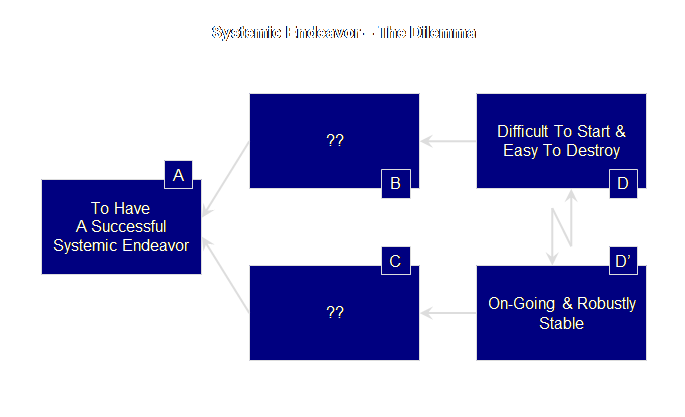
can be expressed as follows; Ø
How
is it that a systemic endeavor once established is on-going and robustly
stable, and yet so difficult to start and also so easy to destroy? To that
statement I would only like to add “apparently so difficult to start,” but I
am getting ahead of myself. What then
are the pre-requisites that give rise to this situation? Of course in a
“blink” I can tell you the reason for how
this is – it is a result of the application of our own common sense, our
so-called common wisdom. That is,
common sense is the cause of the paradox.
But to explain to you the reason why
this happens will take the remainder of the page. And is there a solution to the paradox? Well, yes there is. The solution is a particular mix of; skill,
rational knowledge, and experience – a rather uncommon experience, an expertise
actually – but in no sense restricted or unobtainable. It is exposure to, and assimilation of, the
uncommon rational knowledge, that enables us to first gain, and then to
internalize, the necessary uncommon experience, the necessary uncommon
expertise. I want to explain this in three stages. The first stage is something that we now
“know” and accept as true, but which still, if we are honest, confounds ours
senses – the Copernican Revolution – the fact that the earth moves around the
Sun and around its own axis too. I
want to address the broader issue of learning through this example of the
Copernican Revolution. The Copernican
Revolution in its historic context was as paradigmal then as is any current
systemic, or organizational, or industrial process today, in fact much more
so. Once we have established the story
and the logic for the Copernican Revolution, then we can then port the logic
to develop the case for systemic industrialization, using the broader issue
of managing via the Theory of Constraints as the example. This is the second stage. The third stage returns to the starting
question, the paradox a systemism, and answers it explicitly for the first
time, although by then we will have seen this happen twice already. You will know the answer before we get
there. The three stages are tied
together; firstly by a consistent logic, and secondly by our own individual
need for our sense of identity. You may not wish to know this, but let me
tell you anyway, this is abductive logic.
The three stories, the three explanations, share the same structure,
or rather the same logic, but differ in the details. Abductive logic is important to me. The cloud is a superb example of this type
of logical structure appearing in the same way in different narratives, in
fact allowing us to make sense of apparently different narratives, and it is
the cloud that we will use to illustrate this process. In my earlier iterations of this page I told
this story to completion without the use of clouds. That was in part to overcome the resistance
of those for whom clouds are something to react against. For some people the message is lost in
their reaction to the medium. I no
longer wish to accommodate those who do not wish to make any effort. Some people react simply to avoid the
responsibility that they can see staring them down. If we don’t each develop our own individual
skill for using clouds then we won’t succeed in this transformation. Clouds were born out of necessity, they are
not “nice to haves” they are “need to haves,” otherwise we are forever locked
in a local conflict with no way out. Indulge me for a moment longer. The two “base” clouds that you are going to
see; about learning and the Copernican Revolution, and about managing and the
Theory of Constraints, have a special structure. I will return issues around that structure
towards the end, but for now I just want you to be aware that the “B” entity
is a “subset” or local need, and the “C” entity is a “set” or global
need. As these two clouds unfold you
will see they share a commonality.
This commonality is productive in numerous other clouds once you learn
to use it. Some other “rules” will
fall out as we proceed, and you will find a lot more in the Advanced Section
on the mechanics of clouds. I had to
decide a cut-off, or else we will be here all day, there is much productive
work to be done, but this page was intended to be the last page of (this part
of) the website, and that is the way it should remain. So I’ve pretty
much let the cat out of the bag, we can draw this simple paradox, the paradox
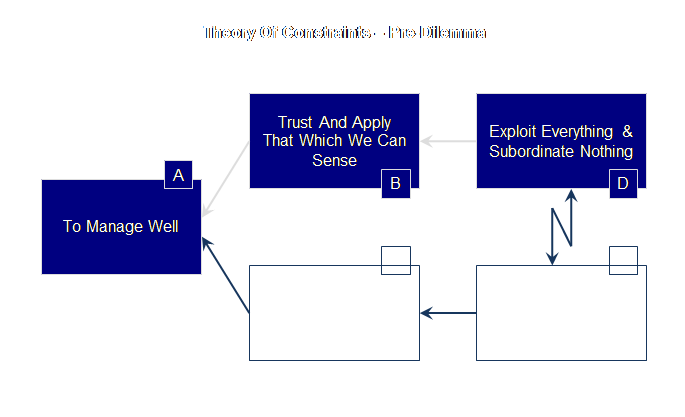
of systemism as a cloud, so let’s do that first – partially complete at least
– and then we will examine the issues around learning and the Copernican
Revolution, then managing and the Theory of Constraints, and then come back
and complete the missing parts of this cloud.
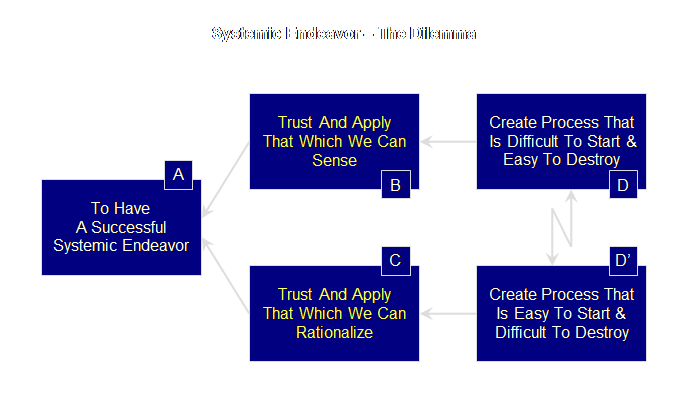
In this cloud there are two mutually exclusive states. One state, the upper arm, is the state of
non-systemism, the state of local optimization. For most people this is also the current
state, and our undesired state, where we have difficulty starting our
systemic endeavors and no difficulty in destroying them. It is what we do have and don’t want.
Now let’s be just a little more particular. The two arms of the cloud, or rather the
two “wants” of the cloud, should be mutually exclusive, and preferrably
opposites of each other – otherwise we might simply oscillate between the
two. The upper arm is about the
beginning and the end – undesirable as it is – whereas the lower arm is about
the middle – desireable as it is.
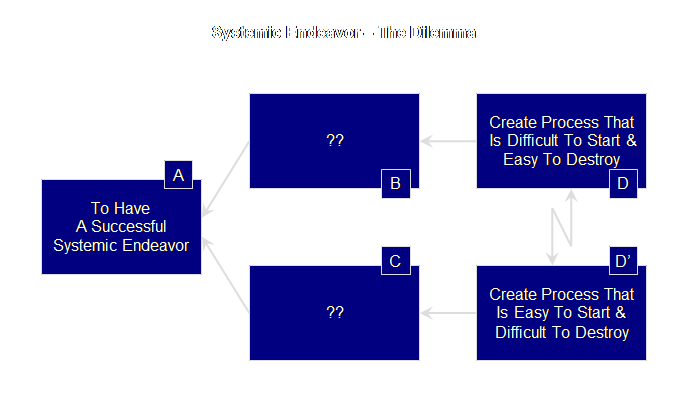
Well, in this game it is often necessary to say what we really mean so
I will reword the cloud a little differently from the formulation of the
original written paradox that we started out with. Additional clarity will not hurt. Let’s have a look.
Before we leave this partially completed cloud, note also how I have
kind of “twisted” the two entities or the two subparts of each entity. The
upper one reads “difficult to start and easy to destroy” and the lower one is
reversed to “easy to start and difficult to destroy.” It seems a feature to me of many paradigmal
clouds that there is often a two-foldedness about the contents of the entity
in conflict. I don’t know if that is a
hard and fast rule, but it certainly seems common and I would encourage you
to watch out for it in the following two examples. Let’s start our exploration then with learning and the Copernican
Revolution. For a general
overview of the Copernican Revolution and its technicality, please see Thomas
Kuhn’s (1957) book, The Copernican Revolution: planetary astronomy in the
development of Western thought. This
work precedes his seminal The Structure of Scientific Revolutions by some 5
years. A more recent, delightful, and
thorough treatment of the Copernican Revolution is Dava Sobel’s (2011) A More
Perfect Heaven: how Copernicus revolutionised the cosmos. It has a great deal of the historic
socio-economic context – or should I say contemporary socio-economic context
of that time. It is a kind of story
behind the story, and the tacit nature of paradigm is imaginatively
illustrated but that is all that I will tell you. It is very
hard for us today to imagine a world in which the size of and distance to the
sun, or any other celestial body, was unknown, unimagined, and
unimaginable. The earth was viewed as
the center of the universe and surrounding it were a series of fixed (solid)
spheres containing the various known planets or wandering stars; the Sun, the
Moon, Mercury, Venus, Mars, Jupiter, Saturn, and Neptune, all moving against
the “fixed” stars of the firmament.
The system of astronomy, instrument-based naked-eye observations, was
used as much for fixing and understanding both past and future happenings on
earth via astrology as for the understanding of the cosmology. There was a strong prevalence even amongst
Copernicus’ closest confidants that the stars preordained one’s future and
explained one’s past. And such a
system had served admirably for some 1300 years since the time of the ancient
Greeks. We can
summarize the pre-dilemma phase as follows;
Why is it that
a system that had served so admirably for so long, should come under the
inspection of Copernicus? In part the
answer to that was to seek greater predictive accuracy, the heavens of that
time were the pre-mechanical clock of the world, and in part it was to remove
the pesky issue of a mathematical construct, used since the Greeks and called
an equant. The pre-mechanical clock of
the universe, while working well on average, sometimes slowed down and
sometimes speed up, that is predicted events could be out by several days
either way, and in the context of a heaven that was believed to be constructed
of perfect spheres this was a worrying anomaly. There is
nothing wrong with an equant per se but
its use in this circumstance was simply inelegant. It was, for lack of a better word, a
mathematical “fudge” that made the astronomical or rather mathematical system
yield numbers that agreed with natural observation. Copernicus realized that his objection to
the use of equants could be overcome by changing the center of the universe
from the earth to the Sun. The suggestion
that the Sun could be the center of the universe was not a novel idea and had
been mentioned a number of times by Arabian astronomers. In fact, Copernicus goes to some length to
invoke the authority of these earlier astronomers who had argued in its
favor. But his use of the idea to
remove the apparent anomaly of equants was original and in doing so he
created a dilemma that occupied mankind for several hundred years and every
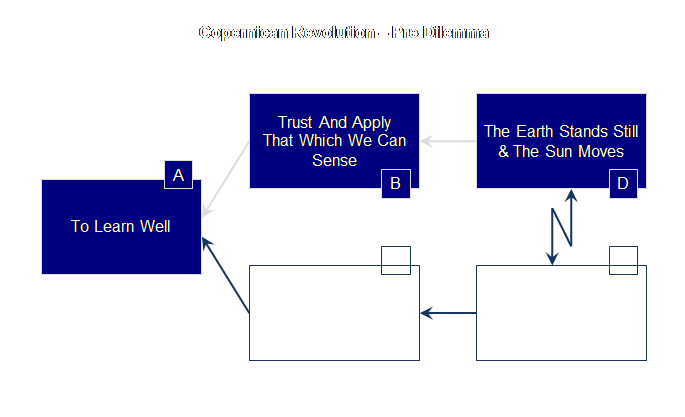
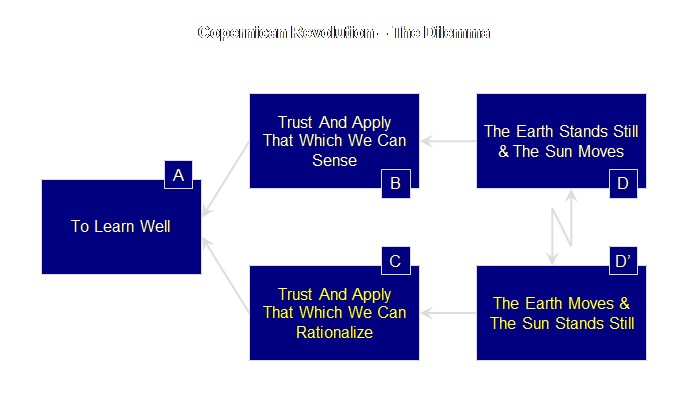
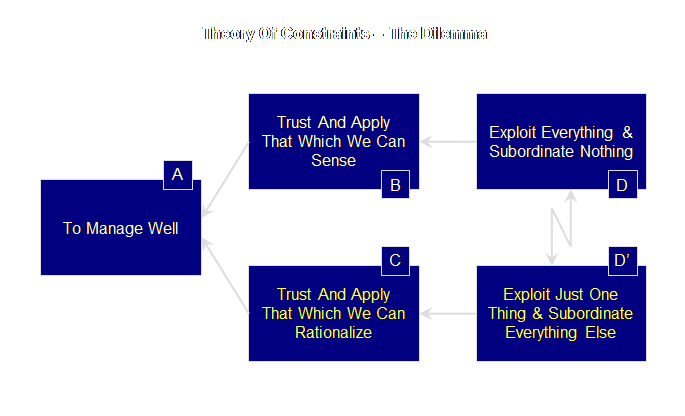
school child since up to a particular age. The full
dilemma is expressed below;
Now let’s be careful. This is not to say that the older
geocentric model was not rational, it certainly was, but Copernicus had taken
things to a higher logical level, a different logical type, an abstraction,
something more than we can directly sense.
In doing so he set up a hypothesis that could either be proved or
disproved in the future but maddeningly unprovable at the time. Copernicus did have the satisfaction of
removing equants from his calculations – and thus a more natural description
of the mechanics of the cosmos, but he also had something much more; he had
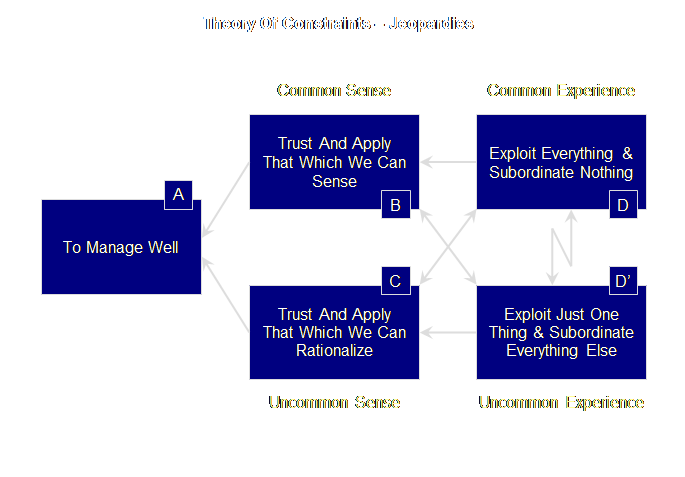
created a new harmony in the heavens. The real issue, however, is not the conflict between
the two outcomes, but rather the contradiction of the senses and of
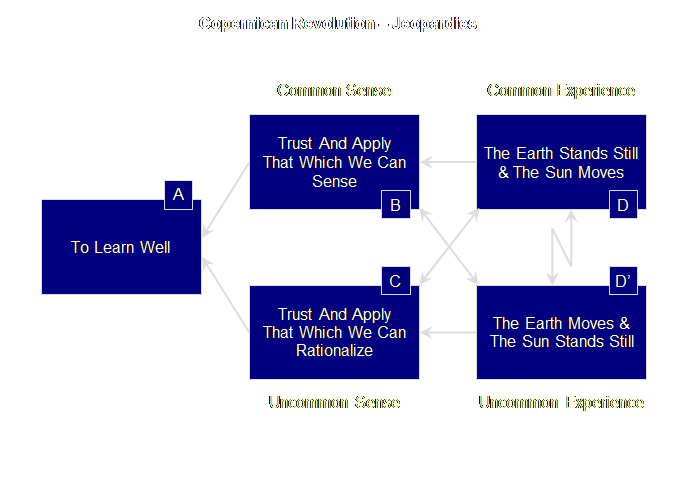
experience; jeopardies in fact. Let’s
have a look at these;
If common
sense jeopardizes the gaining of and new uncommon experience, and common
experience jeopardizes new and uncommon sense, how then did things move
forward? Was it only the inelegance of
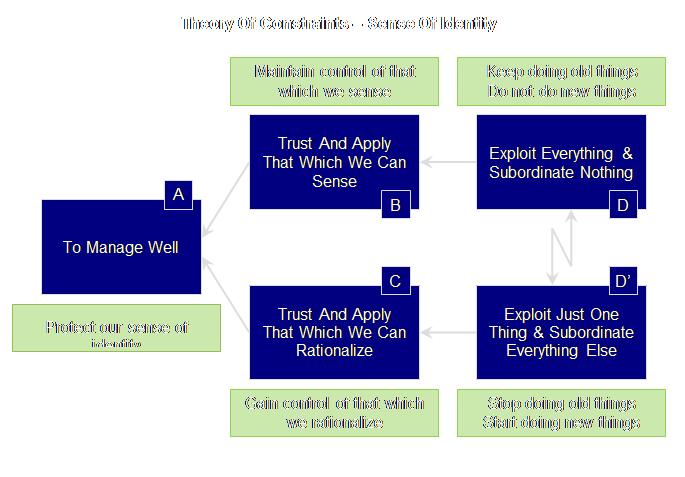
the equant that drove Copernicus to overcome these jeopardies? Well the answer has to be an emphatic no. It is his theology that drove him forward;
his discoveries reinforced his own sense of identity. Paradoxically his passion to prove the
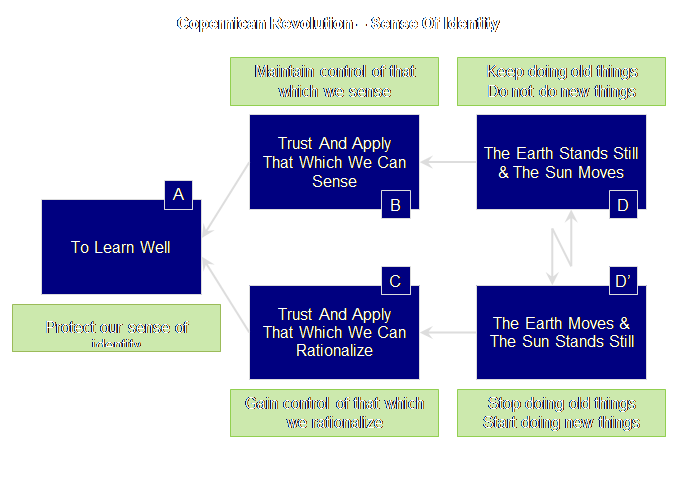
centrality of God, in time, disproved the same. That ironically was never his intent. Let’s look at
this;
Copernicus saw
the Sun as God’s central lantern illuminating his handiwork, he was not the
first to do so, it was a common theme in his
time. Therefore his own sense of
identity as a canon in the Polish Catholic Church was reinforced by his
hypothesis, he was therefore willing to stop doing old things and to start
doing new things, in order to gain control of that which he had
rationalized. His belief and his faith
were one and the same; he had an heuristic passion,
a passion to discover and to learn for himself powered by his faith. He and other mathematical astronomers found
great harmony in the idea of a heliocentric – a sun centered – universe once
it had been proclamated. It redoubled
their faith. For others the very
rock-solid centrality of man and earth and God and the authority of the
scriptures was brought into question and it was viewed as an attack on that
very same faith. The sense of loss of
control for those that had relied upon their senses must have been
profound. It is the two sides of this
dilemma built around our own sense of identity that kept the dilemma open for
so long. One cannot find new evidence
if one is not willing to venture past the jeopardies. Copernicus’
book De Revolutionibus has been described
as “the book that nobody read.” But
Owen Gingerich of Harvard University tracked down 277 copies of the first
edition and 324 of the second. Finding
Kepler’s copy (with the word “ellipse” inscribed by the previous owner in
answer to Copernicus’ concern for epicyclets producing non-circular orbits),
and Galileo’s copy, he decided, that everybody
had read it so to speak. Some copies
going from generation to generation contain annotations in two or three
different hands (Sobel 2011). The outcome of
Copernicus’ rational approach is a unique solution that is independent of place, that is regardless of where we sit in the Copernican
Universe (solar system), we can tell what is happening and
predictively what will happen in the future.
It is this harmony that spoke directly to the
astronomer/mathematicians of the time and those who were to follow. However, for the practical astronomers of
the time Copernicus’ system was neither appreciably simpler nor more
accurate. During
Copernicus’ life-time and for some time thereafter, his ideas remained as
hypothesis, unsubstantiated by any external data. Guided by the harmony that was implied,
Galileo, Kepler, Newton and others found and built productive new
science. However, it wasn’t until 1838
that parallax measurements on nearby stars were accurate enough to determine
that the earth did indeed revolve around the Sun. Today when we
talk about this dilemma it is often about the contradiction of the senses,
but there is a much richer story, and the underlying lesson is that for us,
rationality must finally win out. As Polanyi
(1958) explained; “We abandon the cruder anthropocentrism
of our senses – but only in favor of a more ambitious anthropomorphism of our
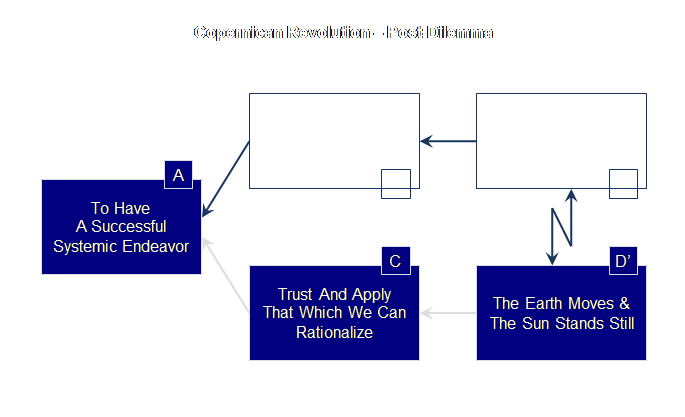
reason.” Let’s have a look at the “modern” post-dilemma
cloud;
We no longer live the
dilemma, the conflict, the contradiction.
And those that did at the time lived it as much as reinforcing their
insider view – which ever side that might have been – and disproving the
complementary outsider view. Rather
today we “switch” views as required.
For the most part we operate as pre-Copernicans, in as much as we fail
to abandon Sunrise, and Sunset, but also acknowledge and accept the
post-Copernican rationalization. There
are very few of us who have become astronauts and they alone are the ones who
have directly experience what for the rest of us is an exceedingly rare
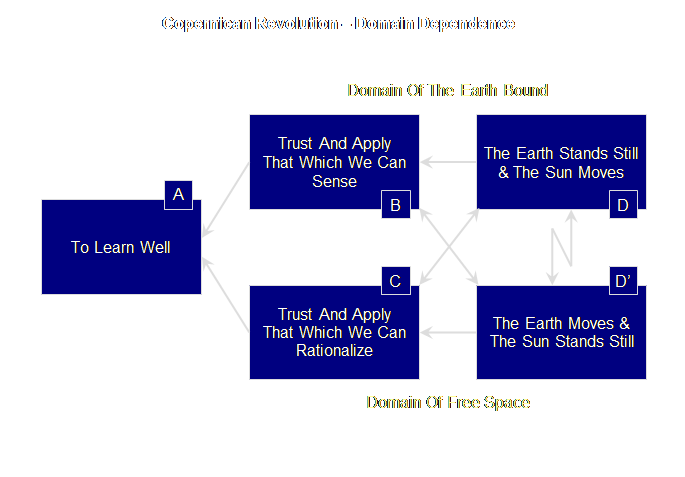
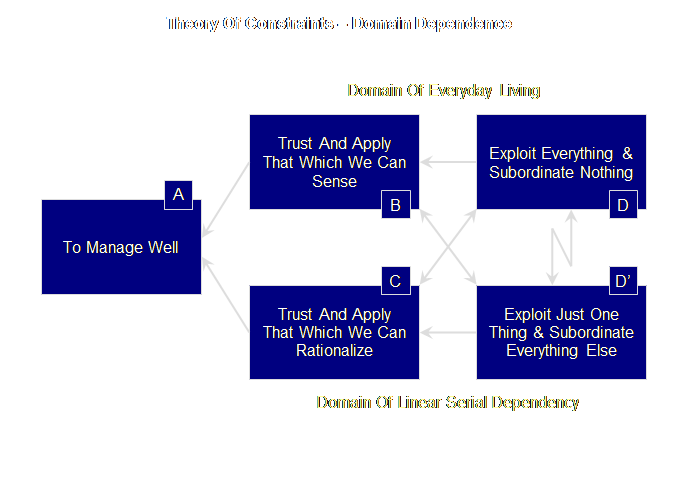
rather than uncommon experience. Why is there a paradox, why is there a dilemma? The first part of the answer is that there
is something in our rationality that contradicts our senses. But what is it? I’ve often called it domain dependence, but
in reality it is a failure to recognize an error of logical type. The rules that apply under the logical type
of our senses do not tell us, and in fact can never anticipate, the rules
that apply under the higher logical type of our sense of senses, our
rationality.
Almost none of us, astronauts excepted, ever venture
into the larger domain of larger logical types and therefore we never worry
too much about the duality of what we sense and what we know. We switch
between the two as need be. And with
that thought, and with some logic, and structure, and understanding under our
belts, let’s now turn our attention to Theory of Constraints and managing our
modern industrial invention, the linear serial dependency, for it is the same
story. Theory of
Constraints is used here as a proxy for all systemic endeavors, not just
Goldratt, but also for Taylor, Shewhart, Deming, Ohno, and Ackoff. These are people for whom the whole was
more important than the parts, and for whom the parts did better for being a
part of the whole. Managerial hierarchy isn’t new, it has existed in
the church, the army, the state, and in various admixtures of the three, at
various scales for maybe 10,000 years or more. But managerial hierarchy within industrial
process is new; it didn’t exist prior to the early 1850’s even in the largest
cotton mills of the time. These
systems employing up to 300 people, still had supervisory foremen who were
workers themselves (Drucker 2006). Up until this
time the pre-dilemma world looked something like this;
In fact, even
today, we (erroneously) know that everyone needs be busy most of the time
(except maybe of course for ourselves), because if they were, then we wouldn’t
have to wait for people upstream to produce the things that we need and we
wouldn’t have to wait for people downstream to be able to receive the needed
things that we have already produced (or be complaining about the new or
different things that they now, suddenly, want produced instead). Except, of course, if we change departments
or positions, and find that now our old department or position is as much a
part of the problem and our new department or position no different from our
experience before. Such analysis shows
a host of non-unique solutions that are each place dependent. Let’s look at
this in another way. We all know that there are folks in the place who are less
effective than they could be, but we are certainly not one of those. However, the same question to each person
yields the same answer. The positional
or departmental viewpoint is a non-unique solution and it is place dependent. We still see this pre-dilemma played out
every time an individual in a group is “reviewed” or “appraised” as an
individual, and rewarded or otherwise as a consequence. We see this pre-dilemma played out in the
Western thinking of worker “compensation” where bonuses demonstrably harm the
system if not the individuals concerned and yet we fail to understand why. Why did this pre-dilemma paradigm last so
long? It lasted so long because as one
moves down the managerial hierarchy, especially pre-industrial hierarchy,
there are more and more individuals doing the work, and more importantly,
they become more and more independent of one another – usually by virtue of
geographic separation – think again of the church, the state, or the
army. The further down the hierarchy
the greater the independence, the greater the ability for local exploitation
to work, or to appear to work. So what changed? Well, let’s have a look. Much has been
made of specialization, but specialization is nothing special. There have always been shepherds, shearers,
fullers, spinners, dyers, and weavers; specialities if not characterized by
age, or gender, or seasonality alone, then certainly by skill and
experience. Ridley (1996) notes the
number of different items found on the 5000 year old mummified remains of a
Neolithic man found in the Tyrolean Alps in 1991 – all products of division
and specialization of labor. And he
goes on to note the “non-zero-sumness” that this achieves; that is, society
can be greater than the sum of its specialized parts. What has
changed is the co-location and lock-step between the specializations and
indeed within any single specialization as mechanization and
industrialization has brought about technical and economic efficiencies that
were beyond the imagination of prior generations. In the terminology of Ackoff (1981/1999) we
have replaced muscle with mechanization and more recently replaced mind with
instrumentation, telecommunication, and computation. During the Industrial Revolution we moved
from loose independent networks of craft made-to-fit, to linear serial
dependencies of manufactured made-to-specification. Although absolute variability went down the
relative importance of the remaining variability rose astronomically. As you well know, and many others do not,
it is the presence of variability and not the absence of hard work that
causes the fluctuations in flow upstream and downstream of each and every
point in the system. As fewer and
fewer entities make more and more of the same output better and better, the
dependency between supplier and supplied becomes
greater and greater. That is not a bad
thing at all, so long as it is understood. Goldratt used
the analogy of a chain to describe such a linear serial process – a chain is
only as strong as its weakest link – and for the first time ever we had a guiding
principle for where to focus our improvement activities and more technically;
where to schedule back from, and also where to schedule forward to. Previous systems did not offer that
simplicity because they all attempted to; manually at first, electronically
later, schedule everything everywhere all of the time. And the advent of electronic computational
power only further fooled us that it was technically possible to do so, even
though we had never asked if it was technically desirable, faith in the old
paradigm of keeping everyone busy drove us on to do it without forethought. So Theory of
Constraints and especially the scheduling system called drum-buffer-rope
presented a dilemma within which we are still largely immersed. It looks like this;
Sure, Taylor
(1911) in his introduction talked about the system rather than man and
implied man must subordinate to the system (“In the past the man has been
first; in the future the system must be first). Deming (1994) talked about the obligation
of a component, but that can be too easily read in the old paradigm of “obligation
to do something” whereas here for the first time it meant “obligation to do
nothing” albeit from time to time. The
issue was somewhat further confused by Goldratt’s use of the term Road Runner Ethic. I am told that Real Road
Runner birds in their native habitat (and the cartoon rendition too) run at
great speed and then stop dead still.
But that is always their normal speed.
However, it lost something in the translation and again it seemed for
many people that we were being asked to behave in the old paradigm of working
harder and faster, albeit for shorter periods with more frequent breaks. Nothing is further from the truth, but the
mis-understanding, indeed the mis-appropriation of the old paradigm for the
new, is still apparent. The cliché
from Taylor’s time of working smarter not harder seems a pipedream for many,
it should not be, it is the only way forward. Once again, the real issue is the contradiction of
our senses and of our experience; jeopardies in fact, rather than the
conflicts between the outcomes. Let’s have
a look at these;
Looking at the
other diagonal, the common experience of being “busy” or at the very least
appearing to “look busy” has literally been beaten into us. Deming said “drive out fear” and I think
that he knew a thing or two. Of course
we hide our productive capacity so that we can respond as quickly as possible,
but it is a delicate balancing act.
Fear has been so well beaten into us that it contradicts and
jeopardizes our ability to rationalize the skills and knowledge of the
uncommon sense needed to operate within the new paradigm. Taylor said as much in 1911 when he rued
that people failed to follow the essence of his methodology, opting instead
for their incomplete and wrong interpretation of the mechanics. Liker showed that the Western
implementations of Toyota’s philosophy have suffered a similar fate. Why, why, why,
is this? The answer to
a large extent lies within each and every one of us and our own sense of
identity. Let’s have a look;
But all is not
lost. There are others for whom the
rationalization – the uncommon sense – put forth is sound, they can see the
evidence of success in other situations, or even in the abstract, and they
take the time to learn and internalize the necessary new knowledge. Frankly they are “big enough” for the job
or they are well supported from higher up within the organization, which in
fact means the same thing. Their sense
of identity will grow around the new knowledge and they will want
to stop doing old things because this now makes new sense to them, and they will want to start doing new things because this too makes
new sense to them, and they will move
forward. Sense of
identity is a metastable product. Many
of us cling to the old one well after its use-by date, some of us never
relinquish it, many though will “cross-over” at some stage, the more that
have already done so, the more likely the laggards will follow. And of course, later on, newcomers don’t
even see the issue. Just think, once,
not so long ago, large inventories were an asset, nowadays they are more
likely, much more likely, to be viewed as the opposite. The world has moved on, but we did not get
there overnight – not all of us that is – but at some stage the metastable
sense of identity around inventory as asset switched over and became
inventory as liability. Rather like
Copernicus in search of the centrality of his God and inadvertently removing
that centrality, Goldratt’s own search for the centrality of the weakest link
has inadvertently removed that weakest link.
Goldratt moved the world from treating each and every link as
exploitable, to only 4 or 5 in the earliest algorithms for OPT (Optimsed Production Technology), to just one in drum-buffer-rope,
and finally none at all in simplified drum-buffer-rope. Conversely, the role of subordination
increased from almost nothing to essentially everything. “A chain is as
strong as it weakest link” was a pre-paradigmal expression, it owes more to the
past than to the present. In fact a
chain should have no weak link, all the links should be demonstrably stronger
than the environment in which it operates.
We are so unused to thinking like this that we fall back to our
pre-industrial idioms with ease.
The outcome of
our rational approach is a unique solution that is independent of place; that
is, regardless of where in the process we sit, we can tell what the output is
and predictively what will be the output in the near future. And let’s be quite sure, the output will be
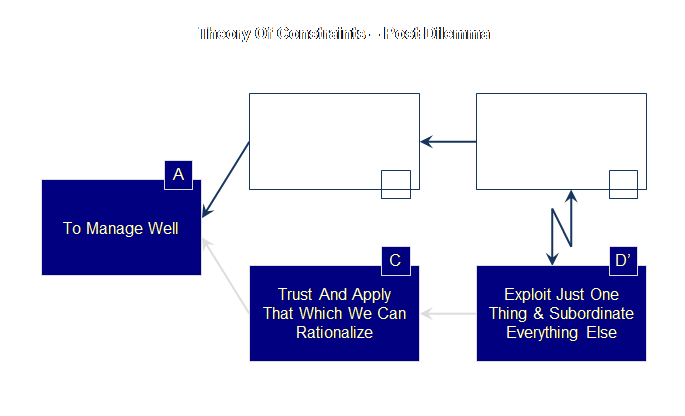
very much greater than anything before. Post-dilemma,
there is no conflict;
Our
rationality gives rise to a harmony, an inherent simplicity, which to my mind
leads us into many other areas of fruitful endeavor which we have hardly
begun to scratch yet. Accounting, or
rather decision making springs to mind.
The same principles have already had a major impact in the areas of
project management, distribution, service operations, healthcare, sales, and
strategy. Many, many, people forget, or indeed have
never known, about one of Goldratt’s necessary conditions for on-going
improvement; that of “provide
employees with a secure and satisfying workplace now and in the future.” It’s the antithesis of the Anglo-American
Social Darwinism of the upper arm of the dilemma, it humanistic in fact,
ultimately it is systemic, it is the form of the post-dilemma cloud, and this
is the direction of the solution. We can
summarize all that we have said mechanistically as; A chain must be stronger than the use it is put to Or more
ecologically; A process must be more capable than the environment
that it operates in Again we must ask why is there a paradox, why is
there a dilemma? And again the first part
of the answer is that there is something in our rationality that contradicts
our senses. But what is it? Once again there is domain dependence, but
in reality it is a failure to recognize an error of logical type.
Much as in the Copernican case we moved away from
being small independent “wholes” to being a “part” of a much greater
interdependent whole. In the larger
scheme of things few of us venture into the domain of these wholes – linear
serial systems – and even fewer of us are asked to manage them in stasis, let
alone improve them. Many, many people
work as individuals, or like individuals, in trades, professions, and
domestic situations. More importantly,
unlike the Copernican case where we can switch freely between the two domains
because one domain is essentially abstract to us, here we fail to switch between
the two even though, or even maybe because, we can move so freely between
them. They look so similar we fail to
recognize the transition. How to switch, and it can be done, is the central
issue of the paradox of systemism.
We’ve visited the problem already, not once but twice, let’s now
return to that problem and solve it once and for all.
Now that we
have journeyed through the Copernican Revolution and through Theory of
Constraints, let’s return back to our original issue, the paradox of
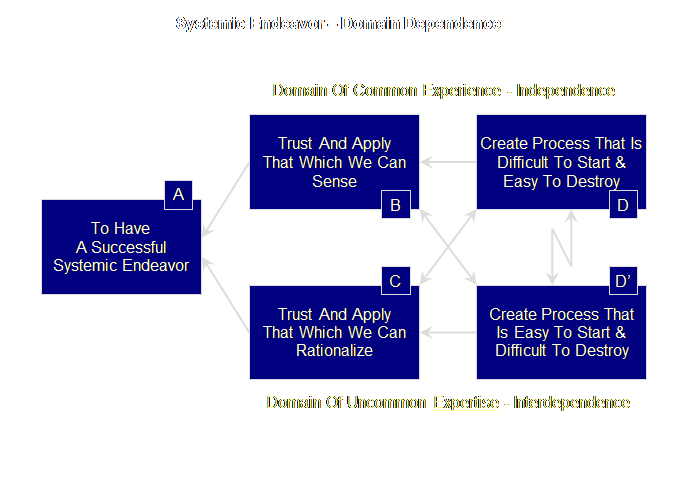
systemism, this is the paradigmal issue that we need to resolve. Here is the modified cloud that we started
with;
The answer
should be familiar to us now; it is the contradiction of our common sense and
our common experience, and the way that this also jeopardizes our sense of
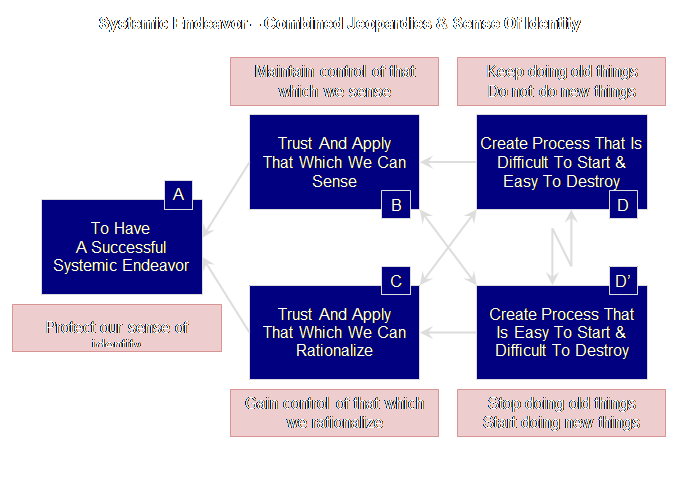
identity. Let’s roll this together for
the first time; we have in the same diagram both the need to protect our
sense of identity and the jeopardy arrows as well;
This tacit and explicit subdivision was my original
basis for subdividing B and C in these clouds; however, they are more of the
nature of a continuum than discrete subset and set. Nevertheless, they are also a powerful
dichotomizing tool as well and useful in parsing information into clouds. We have an illusion of knowledge from the upper
arm. That knowledge is correct in the
prior domain of apparent independence; it is our common sense and our common
experience. This is everything that we learnt in life up until trade or
profession including college or university.
Many of us have been examined to hell to through 3-4 or 5-6 or 8-9
years of “higher” education to ensure conformity to these rules. When we port that knowledge to the lower
arm, the newer domain of serial interdependence, that knowledge is now
incorrect for the new application. It
is now indeed an illusion of knowledge.
We attempt to continue to do the wrong thing righter, rather than the
newer and right thing wronger. And if essentially everyone else is also
doing the wrong thing righter too – then how are we to know that everyone is
wrong and that we are seeking smaller and smaller incremental improvements in
our wrongness? The wrongness is
self-validating is it not? This is an error of logical type. The upper arm, our senses, is of a
different logical type than the lower arm, our rationality, our sense of
senses. To paraphrase Polanyi (1966),
the laws that apply to the upper arm are different to the laws that apply to
the lower arm. The operations of the
lower arm, our rationality, cannot be accounted for by the laws governing its
particulars forming the upper arm. That is to say the laws of our rationality cannot be
accounted for by the rules of our common sense. Common sense must be subordinate to
rationality. When we fail to do this
we make an error of logical type. We are told that profound knowledge must come from
outside the system – and it does, but that doesn’t mean we have to re-invent
it every time either. To attempt to do
so would be absurd. The knowledge
exists and it came from outside; physicists like Goldratt and Deming, the
science philosophers of Ackoff, Bateson, Kuhn, and Polanyi, the engineers of
Taylor, Ohno, and the Toyodas. But how
do we get it “in.” And for that matter
how do we get it to stay “in.” There is a double whammy of apparent emotional
arrogance and apparent intellectual ignorance – I say “apparent” because we
are beings of positive intent. Either
“side” of this cloud may be construed by the other to have these
attitudes. Both of these smacks of insecurity because for someone to address these
qualities on either side requires some sort of introspection and the insecure
just won’t go there. Moreover the
insecure will build the virtue of their “side” as a defense against the
“attack” of the other and things quickly build to an impasse (or worse). How then do we
build the security for the introspection?
How do we get past the impasse?
And the answer is that there are two complementary ways which are path
dependent; one tacit and one explicit. We should
start with the tacit first and we should start with ourselves – those of us
who are reading these pages and leading others. A tacit experience breaks in an instant the
paradigmal contradiction. Once broken
it can’t be glued back, we cannot un-know what is now known to us as a new
experience. We have the luxury of
being able to break our specific paradigmal issue this way. And of course it is playing (not saying)
the dice game that does this. How
often are we tricked by our own knowledge into telling
people about the dice game – but not allowing, or rather not insisting, that
they do it.
We deprive people of a primary learning experience. Think of System Dynamics and the Beer Game;
same thing. Or Statistical Process
Control and the Bead Experiment. Like
the proverbial skill of fork-lift driving, everyone talks about how they can
do it – except that they can’t.
Everyone thinks that they can run a supply chain – until they find
that they can’t even run the Beer Game.
Everyone thinks that they are in control – unitl
they are fooled by randomness. That thing
learnt from the tacit experience of the dice game and its variants is going
to depend to some extent on the skill of the presenter, but it is a wedge,
albeit a very small wedge, in the door of the brain opening up the
possibility of a new and uncommon sense leading onto uncommon expertise. And actually that is all that we need. Sometimes the simplicity is scary and it
plays on our own insecurity, it should not, we should be secure in the soundness
of our fundamental knowledge. And this
wedge leads us to the second part. And
again let’s start with ourselves. We
can’t blame “them” for what they don’t know; we can only blame ourselves for
what we can’t properly explain to them.
Let’s look at the explicit dimension. The cloud is
the premier explicit device for explaining the new knowledge and
understanding around the new found tacit experience. Goodness, we’ve just used it to explain the
“mother of all” paradigmal issues; the Copernican Revolution. And we, those of us on the lower arm, don’t
know too much about what a cloud can do.
If I had to hazard a guess I’d say we know about half of what we
should and practice just a small portion of that. And I hope that I am wrong, I hope that
there is even more to know, because so far it’s a pretty damn impressive
tool. The cloud has
a richness that was previously unsuspected; you will find evidence of this in
the Advanced Section [and two newer webinars at TOCICO]. When I originally wrote the three clouds
used here I didn’t know about these more advanced (actually more simple)
approaches. So, in fact, neither do
you have to know about it, but you will
find it useful. Some people have
reacted against this, others have absorbed it productively. I have to say that I don’t care. I only care about people who want to make an improvement to their lives and to the
lives of others. People who want to but can’t
do. I don’t want to see people trapped
within their current paradigm because of our inability to bring them out of
it. I have used
the 3 different clouds that appear on this page to move people. Firstly the Copernican Revolution,
something that people know of and accept.
An anchor if you like. Then the
Theory of Constraints, something people usually know of in their heart of
hearts but have never thought about before and have yet to accept. This pair of clouds contains all the
conflicts and contradictions mirrored in one another abductively. The third cloud is actually the “shadow”
cloud about our own sense of identity, the need for control, the want to do
or not to do, and it really brings all of the issues home. It is very seldom that people are faced
with such honest introspection. It has
to be handled with sensitivity. It has
to be handled with consummate skill. That is the
way that we break the paradox of systemism.
That is how we take something that was previously difficult to start
and easy to destroy and make it easy to start and difficult to destroy. And we are just starting on this journey. Let me leave you with this thought from Frederick
Taylor in 1911; The history of the development of scientific management up to date, however, calls for a word of warning. The mechanism of management must not be mistaken for its essence, or underlying philosophy. Precisely the same mechanism will in one case produce disastrous results and in another the most beneficent. The same mechanism which will produce the finest results when made to serve the underlying principles of scientific management, will lead to failure and disaster if accompanied by the wrong spirit in those who are using it. Hundreds of people have already mistaken the mechanism of this system for its essence. Mistaking the mechanism for the essence is an error
of logical type. We must learn to stop
doing this. Ackoff, R.L., (1999) Ackoff’s Best: his classic writings on management. John Wiley & Sons, Inc., pp 24-25, originally published 1981. Bateson,
G., (1972) Steps to an ecology of mind.
The University of Chicago Press, pg 314. Deming,
W. E., (1994) The new economics: for industry, government, education. Second
edition, MIT Press, pg 95. Drucker,
P.F., (2006) Classic Drucker. Harvard
Business School Press, pg 181.
Originally published 1988. Goldratt, E. M.,
(1990) The haystack syndrome: sifting information out of the data
ocean. North River Press, pp 11-13. Gould, S.J., (2000) A tale of two worksites, pg 262. In: The lying stones of Marrakech: penultimate reflections in natural history. Vintage, 372 pp. Hofstadter, R., (1959) Social Darwinism in American thought. George Braziller Inc. Kuhn, T. S., (1957) The Copernican revolution: planetary astronomy in the development of Western thought. 24th printing 2003, Chicago, 297 pp. Polanyi, M., (1958) Personal knowledge: towards a post-critical philosophy. Paperback edition 1974, Chicago, pp 4-5. Polanyi, M., (1966) The tacit dimension. Chicago, pg 36. Ridley, M., (1996) The origins of virtue. Penguin Science, pg 48. Sobel, D., (2011) A more perfect heaven: how Copernicus revolutionized the cosmos. Bloomsbury, 273 pp. Taylor, F.W., (1911) The principles of scientific management. 1998 edition Dover Publications, pp iv, 67. This Webpage Copyright © 2013 by Dr Kelvyn Youngman |