|
A Guide to Implementing the Theory of
Constraints (TOC) |
|||||
|
Why The
OODA Loop? Why include discussion
on the OODA Loop? Well, because the
OODA Loop, or Boyd Cycle, is conceptually a very important part of what we
are trying to achieve. Likewise,
Nonaka and Takeuchi’s recognition of the role of both tacit and explicit
knowledge is conceptually important.
Senge’s recognition of leverage and detail/dynamic complexity is also
conceptually important. We need these
concepts to enrich and to better appreciate both how we can apply the Theory
of Constraints, and the implications of that usage. We have used
the cloud to suggest that a “looping” type decision structure can be
constructed using Theory of Constraints Thinking Process tools, and yet our
intuition tells us that even if we formalize the process as such, in reality
we think in a far more massively parallel and messy way than this. We need to look at the OODA Loop to better
appreciate this messiness before returning once more to the implications of
Theory of Constraints. Let’s have a
look then at this concept – the OODA Loop – the Boyd Cycle. The OODA Loop is
not a loop (1). That came as quite a
shock. Maybe I have been reading with
my eyes closed. Time for one of those
reality checks. Maybe we are all too
familiar with the concept of the Shewhart cycle that Deming taught (2). Or too familiar with one of the many
derivatives – such as the plan-do-check-act or PDCA cycle of TQM. Let’s draw the
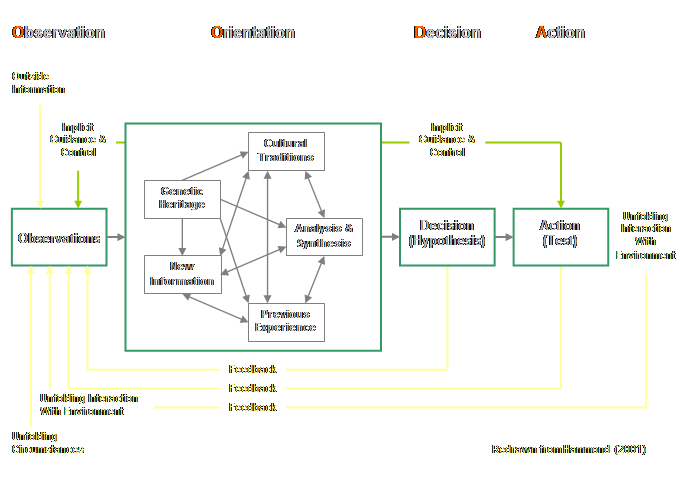
OODA Loop and examine it in more detail.
That way we can be sure that we won’t continue to build on previous
errors.
Do you
remember the short discussion on feedback in the page on people?
Margaret Wheatley characterized feedback in a system in number of ways
(3). Let’s list them again here. (1) Feedback is self-generated, an
individual or system notices whatever they determine is important for them
and they ignore everything else. (2) Feedback depends upon the context,
the critical information is being generated right now, failing to notice the
"now," or staying stuck in past assumptions, is very dangerous. (3) Feedback changes; what an
individual or system chooses to notice will change depending on the past, the
present, and the future. (4) New and surprising information can
get in, the boundaries are permeable. (5) Feedback is life-sustaining, it
provides essential information about how to maintain one's existence, it also indicates when adaptation and growth are
necessary. Wheatley’s
characterization of feedback meshes pretty well with the OODA Loop. We notice (observe) whatever is important
(orient) and ignore everything else.
Feedback depends upon the context (orientation). Feedback changes (unfolding circumstance
and unfolding interaction with environment).
The boundaries are permeable (outside information). It provides essential information
(decision), it indicates when adaption and growth are necessary (action). Feedback is
absolutely essential. However, we
observe feedback and new information through a lens, the lens of our own
prior orientation, and sometimes there is a gap between observation and our
prior orientation. One of the best
illustrations of the gap between observation and orientation comes from
Thomas Kuhn’s description of the discovery of Uranus. We can learn a lot from this simple
example. “On at least seventeen different
occasions between 1690 and 1781, a number of astronomers, including several
of Europe's most eminent observers, had seen a star in positions that we now
suppose must have been occupied at the time by Uranus. One of the best observers in this group had
actually seen the star on four successive nights in 1769 without noting the
motion that could have suggested another identification. Herschel, when he first observed the same
object twelve years later, did so with a much improved telescope of his own
manufacture. As a result, he was able
to notice an apparent disk-size that was at least very unusual for
stars. Something was awry, and he
therefore postponed identification pending further scrutiny. That scrutiny disclosed Uranus' motion
among the stars, and Herschel therefore announced that he had seen a new
comet! Only several months later,
after fruitless attempts to fit the observed motion to a cometary orbit, did
Lexell suggest that the orbit was probably planetary. When that suggestion was accepted, there
were several fewer stars, and one more planet in the world of professional
astronomy. A celestial body that had
been observed off and on for almost a century was seen differently after 1781
because...., it could no longer be fitted to the perceptual categories (star
or comet) provided by the paradigm that had previously prevailed (4).” Thus although feedback and observation functioned
perfectly in this example (all the evidence was there) it took some time for
the correct orientation to develop (for new information to leak in) and allow
for the full recognition of the observed phenomena. The awareness of mismatches, of gaps, is an
important part of Boyd’s approach.
Sometimes, however, we are not fully aware of the mismatches due to
our own orientation. The orientation
stage (the big “O”) of OODA is far more important than we might first
conceive. Boyd explained the orientation stage as follows (5); “Without our genetic heritage, cultural traditions,
and previous experiences, we do not possess an implicit repertoire of
psychophysical skills shaped by environments and changes that have been
previously experienced. Without analysis and synthesis, across a variety of
domains or across a variety of competing independent channels of information,
we cannot evolve new repertoires to deal with unfamiliar phenomena or
unforeseen change. Without a many-sided implicit cross-referencing
process of projection, empathy, correlation, and rejection (across many
different domains or channels of information), we cannot even do analysis and
synthesis. Without OODA loops, we can neither sense, hence
observe, thereby collect a variety of information for the above processes,
nor decide as well as implement actions in accord with those processes. Or put another way, without OODA loops embracing all
the above and without the ability to get inside other OODA loops (or other
environments), we will find it impossible to comprehend, shape, adapt to, and
in turn be shaped by an unfolding, evolving reality that is uncertain,
ever-changing, and unpredictable.” Orientation
is; the worldview, the schemata, the mental models, the views of reality, the
insights, intuitions, hunches, beliefs and perceptions of the various
participants. We create working models
of the world by making and manipulating analogies in our minds. With these working models we perceive and
define our world (6). They are our
maps of reality – and they are implicit. It is the
implicit nature of the OODA Loop that is not well understood. Robert Coram expresses the confusion the arises
between the explicit and implicit states of OODA best (1); “The OODA Loop is
often seen as a simple one-dimensional cycle, where one observes what the
enemy is doing, becomes oriented to the enemy action, makes a decision, and
then takes an action. This
"dumbing down" of a highly complex concept is especially prevalent
in the military, where only the explicit part of the Loop is understood. The military believes speed is the most
important element of the cycle, that whoever can go through the cycle fastest
will prevail. It is true that speed is
crucial, but not the speed of simply cycling through the Loop. By simplifying the cycle in this way, the
military can make computer models. But
computer models do not take into account the single most important part of
the cycle ‑ the orientation phase, especially the implicit part of the
orientation phase.” Thus we come back to the two “implicit guidance and
control” arrows that we mentioned earlier.
Let’s return to Robert Coram once again (1). “Note that Boyd includes the ‘Implicit
Guidance & Control’ from ‘Orientation’ with both ‘Observations’ and
‘Action.’ This is his way of pointing
out that when one has developed the proper Fingerspitzengefuhl [ fingertip
feel ] for a changing situation, the tempo picks up and it seems one is then
able to bypass the explicit ‘Orientation’ and ‘Decision’ part of the Loop, to
‘Observe’ and ‘Act’ almost simultaneously.
The speed must come from a deep intuitive understanding of one's
relationship to the rapidly changing environment. This is what enables a commander seemingly
to bypass parts of the Loop. It is
this adaptability that gives the OODA Loop its awesome power.” Thus we can see that the OODA Loop, at one level,
might be interpreted as an iterative explicit loop. But it is also a model of our implicit
non-linear reaction to circumstances once the reaction has been learnt. The OODA Loop is both a model of the context
of discovery and the context of justification. We will return to these two concepts
shortly. First, however, lets consider
a little more the implications of orientation – especially where the
orientation worldview differs not on aspects of detail complexity, but rather
on aspects of dynamic complexity. Imagine, as an
example, if your opponent’s world view is attrition warfare, and yours is
maneuver warfare (7). They use a
hierarchy of standardized massed forces, massive fire-power, well supplied,
and under centralized command and control.
You use a network of adaptive, innovative, fast and deadly mobile
forces, under decentralized leadership designed around initiative and
trust. You probe and push looking for
areas of weakness in your opponent’s plan to either exploit or utilize to sow
confusion. Which do you think is the
more likely to win? Imagine now if
you could teach, as Boyd did, the underlying principles of dog-fights to any
fighter pilot – not just to those for whom it is already intuitive. What if you could teach the underlying
dynamic of energy maneuverability so that every pilot knows not only the
principles for successfully completing a dog-fight once engaged, but also
when and where and if to successfully engage each opponent in the first instance. Imagine
if your pilots have absorbed that skill and your opponent’s pilots don’t have
that skill? Hold onto
these thoughts for a moment. We haven’t
really used the terms “cost world” and “throughput world” in these pages
although they occur from time to time in the Theory of Constraints
literature. Goldratt calls the world
of management decisions that are based upon product cost considerations the
“cost world.” The cost world is
pre-occupied with operating expense and independence (8). In contrast Goldratt calls the world of
management decisions that are based upon throughput considerations the
“throughput world.” The throughput
world is pre-occupied with throughput and dependence (8). We have used other terms in these pages –
the reductionist/local optima approach and the systemic/global optimum
approach – in almost the same way as cost world and throughput world if only
to broaden their impact beyond financial considerations. Imagine then
if your opponent’s world view is the cost world, and yours is the throughput
world. They believe in product cost,
product profit, local optimization, local safety, independency, efficiency,
variance reporting and centralized command and control. You know only process profit, throughput,
system dependency, constraints and non-constraints, global safety,
effectiveness, decentralized alignment and leadership around the system’s
goal. You probe and push looking for
areas of weakness in your opponent’s commercial activities to either exploit
or utilize to sow confusion. Which do
you think is the more likely to win? Imagine now if
you could teach the underlying principles of systemic production management
or replenishment management or project management to anybody – not just to
those for whom it is intuitive. What
if you could teach the underlying dynamic of exploitation and subordination
so that everybody knows not only the principles for successfully completing a
competitive job once engaged, but also when and where and if to successfully
engage the competition in the first instance.
Imagine if your people have absorbed those skills and your opponent’s
people don’t have those skills? Does this help
you to understand that when Boyd talks of operating inside someone’s decision
cycle, it is not your ability to “do the thing right” quicker and more
frequently that the opponent, it is the ability to “do the right thing.” That is really what operating inside
someone else’s decision cycle is all about.
And until the systemic/global optimum approach is better known then
the competitive advantage of using it is very strong indeed. Let’s have a look at a simple military
analogy; “Razz had his
work cut out. Then he remembered the
maneuver John Boyd taught at the FWS, the one that had so astonished him with
its elegant simplicity: the roll to the outside in order to gain the tactical
advantage. It was a maneuver contrary
to everything a fighter pilot thought he knew about aerial combat, but a
maneuver that put a pilot tight in on his adversary’s six…” “Razz briefed
more than sixty pilots in the wing.
And after every mission up North, he had pilots practice the maneuver
on the way back to Ubon. Again and
again they practiced.” “January 2,
1967, was the greatest day the Air Force had during the Vietnam War. Bolo went into the history books. But what Razz remembers is that six of the
seven kills that day were done by pilots who used John Boyd’s outside roll at
some point in the engagement (9).” Do you think
those pilot’s in the middle of a dog-fight made a conscious step-wise
evaluation of what to do next? I don’t
think so, it was implicit, sub-conscious, an auto-reflex based upon learning
and then practice, practice, and more practice. That this was the “right thing to do” had
been decided a long time ago. And
“doing it right” was automatic. In
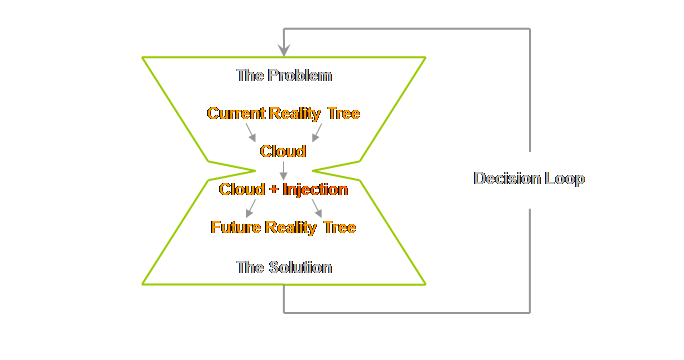
execution, it was hardly a decision loop at all. So maybe the
model that was presented to explain the “loopability” of the Thinking Process
tools is wrong. It was a simple model
of a cyclic decision loop. Let’s draw
it again.
"Historians and philosophers of science often
make a distinction between the logic and psychologic of a scientific
conclusion ‑ or, in the jargon, 'context of justification' and 'context of
discovery.' After conclusions are
firmly in place, a logical pathway can be traced from data through principles
of reasoning, to results and new theories ‑ context of justification. But scientists who make discoveries rarely
follow this optimal pathway of subsequent logical reconstruction. Scientists reach their conclusions for the
damnedest of reasons: intuitions, guesses, redirections after wild-goose
chases, all combined with a dollop of rigorous observation and logical
reasoning to be sure ‑ context of discovery." Clearly the model above is built with the context of justification in mind. If we extend the argument to Boyd’s OODA
Loop, then it is built more in the mode of context of discovery. It describes the process of discovery. It describes the process of discovery and
it can also be used to describe the context of justification – the simple
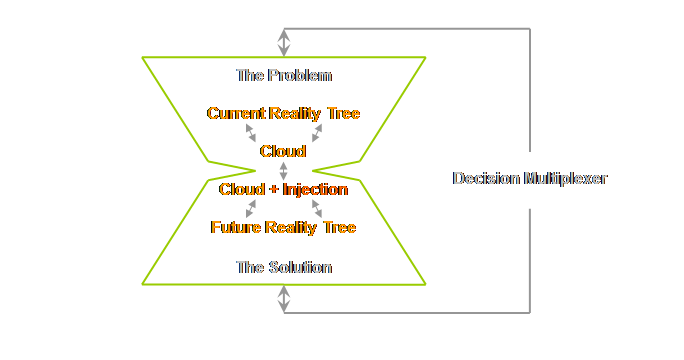
explicit loop that so many people see. So really we need to re-jig our simple model; we
need to accommodate the parallel and messy nature of discovery. Let’s do that. Let’s allow it to reflect the context of discovery.
If all your
experience is in cost reduction and local efficiency improvement you will see
particular solutions in your mind – solutions that have worked for you or
others in the past. This alone will
pre-determine the nature of the problem that you see as well. It will pre-determine what you chose to
notice. Equally well if all your
experience is in throughput enhancement and global improvement you will see
particular solutions in your mind and this will once again pre-determine the
nature of the problem that you chose to notice. The human mind is massively parallel in its
operation. It is only computer
algorithms that loop around in a repetitive and mechanistic way. We need to
acknowledge this messiness. Boyd did
so in the orientation stage of his process.
And in his description of this stage he used two rather important
words – “projection” and “empathy.”
What the heck have projection and empathy got to do with
discovery? Gould described scientific
discovery as in part; “intuitions, guesses, redirections after wild‑goose
chases.” What is happening is that we
are triangulating in on a poorly verbalized part of discovery – abduction. Let’s continue
with Stephen Jay Gould (10). “This
messy and personal side of science should not be disparaged, or covered up for
two major reasons. First, scientists
should proudly show this human face to display their kinship with all other
modes of creative human thought…”
“Second, while biases and preferences often impede understanding,
these mental idiosyncrasies may also serve as powerful, if quirky and
personal, guides to solutions. C.S.
Peirce (1839-1914), America’s greatest philosopher of science, even coined a
new word to express the imaginative mode of reasoning involved in such mental
leaping: abduction, or 'leading from' (one place to another), to contrast
with the more sedate and classical modes of deduction, or logical sequencing,
and induction, or generalization from accumulated particulars (all from the
Latin ducere, 'to lead').” Without
projection and empathy we can not even do analysis and synthesis. Projection and empathy describe
abduction. To analyze we need
deduction and induction, to synthesis we must have abduction as well. To understand systems in their entirety we
must have abduction, because the moment we start to look at the parts of the
system we can no longer understand the system itself. In fact we
have already come across “abduction” previously in the page on leadership and
learning. Nonaka and Takeuchi consider
it important in the conversion of tacit knowledge to explicit knowledge;
“This process of converting tacit knowledge into explicit knowledge is
facilitated by the use of multiple reasoning methods such as deduction,
induction, and abduction. Particularly
useful for this phase is abduction, which employs figurative language such as
metaphors and analogies.” What is our
world view composed of, the big “O” of orientation, the manipulation of
analogies in our minds. Let’s return
for a moment to the five step focusing process of Theory of Constraints, the
one that we have called our plan of attack.
Do you remember the 5th step as we wrote it previously? Let’s rewrite it here. (5) If in the previous steps a constraint has been broken Go back to step 1, but do not allow inertia to cause a
system constraint. In other words; Don’t Stop. Let’s see what
Coram had to say about the OODA loop once it starts (11); “A crucial
part of the OODA Loop – or ‘Boyd Cycle,’ as it has come to be known – is that
once the process begins, it must not slow.
It must continue and it must accelerate. Success is the greatest trap for the novice
who properly implements the OODA Loop.
He is so amazed at what he has done that he pauses and looks around
and waits for reinforcements. But this
is the time to exploit the confusion and to press on.” Now can anyone
tell me if there is any difference between this admonishment for the OODA and
Goldratt’s 5th step? Check back to the
discussion on inertia in the page on the process of change. Pausing at the 5th step is so common. This the exact moment when others, for
example “the back to Egypt crowd (12),” will try to undo the success. Of course we
can avoid this tactical blunder by having a proper strategy in place – can’t
we. It is called the holistic
approach. Boyd’s trinity
was; people first, ideas second, and things third (13).
The OODA Loop encapsulates Boyd’s understanding of the development of
ideas, the process of discovery, and is presented within the context of
discovery. Its real power lies not in the mechanistic,
iterative, explicit loop of observe, orient, decide and act, but rather in
the implicit and direct interaction between observe and act within the
context of prior orientation through trail and error, learning and
doing. When the working model produced
in the orientation stage is based upon a dynamic that allows a competitive
advantage, and that dynamic is fully understood and once again fully
internalized, then the OODA Loop explains the way in which we can work inside
other peoples’ decision cycles.
Gaining a competitive win every time. The OODA Loop is “simple yet comprehensive and
elegant (4).” (1) Coram, R.,
(2002) Boyd: the fighter pilot who changed the art of war. Little, Brown and Company, pg 335. (2) Deming, W. E., (1982) Out of the crisis. Massachusetts Institute of Technology,
Centre for Advanced Education, pp 86-89. (3) Wheatley, M. J., and
Kellner-Rogers, M., (1999) What Do We Measure and Why? Questions About The
Uses of Measurement. Journal for
Strategic Performance Measurement, June. (4) Kuhn, T. S., (1996) The
structure of scientific revolutions, 3rd edition. The University of Chicago Press, pg 115. (5) Hammond, G. T.,(2001) The mind of war: John Boyd and American security. Smithsonian Institution Press, pg 189. (6 Nonaka, I.,
and Takeuchi, H., (1995) The knowledge-creating company: how Japanese
companies create the dynamics of innovation.
Oxford University Press, pg 60. (7) Hammond,
G. T., (2001) The mind of war: John Boyd and American security. Smithsonian Institution Press, pp 151-153. (8) Goldratt, E.
M., (1990) The
haystack syndrome: sifting information out of the data ocean. North River Press, pp 52-54. (9) Coram, R., (2002) Boyd: the fighter pilot who changed the art of war. Little, Brown and Company, pp 214-215. (10) Gould, S. J., (1996) Mind of the Beholder. In: Dinosaur in a haystack. Penguin Books, pg 94 (11) Coram,
R., (2002) Boyd: the fighter pilot who changed the art of war. Little, Brown and Company, pp 338. (12) Woeppel,
M. J., (2000) Manufacturer’s guide to implementing the Theory of
Constraints. St. Lucie Press, pg
41. Quoting John Covington. (13) Hammond,
G. T., (2001) The mind of war: John Boyd and American security. Smithsonian Institution Press, pg 110. This Webpage
Copyright © 2003-2009 by Dr K. J. Youngman |