|
A Guide to Implementing the Theory of
Constraints (TOC) |
|||||
|
All Singing From The Same Systemic Song Sheet The Constraint Management Model for Strategy which we examined on the
previous page is a superb approach for organization-wide improvement when
everyone is already aligned and singing from the same song sheet – or at
least is willing to do so. It is without
doubt a systemic/global optimum approach.
The holistic approach is also a systemic/global optimum approach but
one borne out of the experience that not everyone initially wants to, or
understands the need to, or even knows how to sing from the same systemic
song sheet. Experience suggests that contrary to expectation, a substantial and
rapid but localized success in the implementation of any one of the Theory of
Constraint logistical or non-logistical applications will not result in a
steady and system-wide uptake of that success. Indeed the opposite may well occur and may
eventually result in the winding-back of the initial genuine but localized
success. If we are in the business of
moving organizations towards their stated goal, then clearly this will not
do. The holistic approach sets out to
ensure that everyone understands, and is in agreement, as to what must
be done before there is any attempt to undertake it (1). Sometimes it is easier to define the holistic approach by what it is not
rather than by what it is, so let’s start there.
The holistic approach is not the courageous successful implementation
of a single Theory of Constraints application, either logistical or
non-logistical. This arises because
the successful implementation of any of the Theory of Constraint solutions
generally results in the breaking of the previously perceived
constraint. That is great – but by
definition the constraint has to have moved somewhere else – unless you are
making infinite throughput – and I don’t think anyone has seen this yet. Herein lies the problem. Imagine for instance that you are in marketing and the constraint is
in production. The production people
break the constraint. Big deal. You could have written a list, as long as
your arm, of reasons why production couldn’t meet the market. Now they claim the constraint is in
marketing but they don’t have a clue just how different marketing is from
production. Or imagine that you are in production and the constraint is in
marketing. The marketing people break
the perceived constraint. Big
deal. You could have written a list,
as long as your arm, of reasons why marketing couldn’t beat the market. Now they claim the constraint is in
production but they don’t have a clue just how different production is from
marketing. Who is right? Well both are
right, and both are wrong. If it had
have been easy to break the constraint in another area it would have been
done. That it wasn’t done previously
proves that it wasn’t simple.
Unfortunately nobody will see that. Let’s repeat that – unfortunately nobody will see that if it had have
been easy to previously break the constraint it would have been done. Subsequent to a successful localized implementation a number of
different things might then occur. At
the best the implementation will peak and remain static. Many people will in fact be very happy to
have achieved such an improvement and to maintain it. At worst, however, a number of ill effects
may arise and often the implementation will slowly degrade. Generally, people who were not intimately
involved in the implementation will begin to “unpick the threads” from the
sidelines. To counter such actions we
must remember Goldratt’s first law of business “be paranoid.” Not to be confused with his second law
which is also “be paranoid!” If you
think people are unpicking the implementation, then they most probably are. Saying “yes” and doing nothing is a
reasonable indicator of a slow unraveling.
After all isn’t this how most improvement initiatives – even
successful ones – have been defeated in the past. Maybe we are now in better position to define the holistic approach. The holistic approach is a means of ensuring a process of on-going
improvement. Remember our leverage
curves on the page on process of change?
But how do we ensure that the process will be on-going whenever it
jumps a boundary between functional or logistical or business units? Goldratt’s answer to this problem is to
ensure at the outset that the top leadership/management of the organization
understands; (1) The system. (2) The goal
of the system. (3) The necessary
conditions. (4) The fundamental
measurements. (5) The role of the constraints. Essentially we are asking that the reductionist/local optima view be
reframed and replaced with the systemic/global optimum approach. The mechanism for obtaining this is a series of video presentations
first broadcast internationally in 1999 and now available both as video tapes
for groups and CD-ROMs for self-learning purposes (see links and
resources). This enables management to
understand the problems, the interactions, and the solutions for each other’s
area. Thus production gains insights
into marketing and sales. Marketing
understands production, distribution, and accounting. The presentations provide the vision and understanding for “why
change.” The subsequent facilitation
addresses “what to change,” what to change to,” and how to cause the change.” Properly facilitated this approach will ensure a true process of
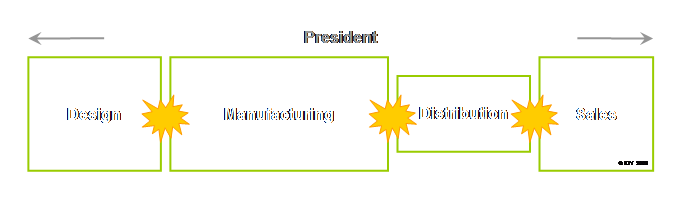
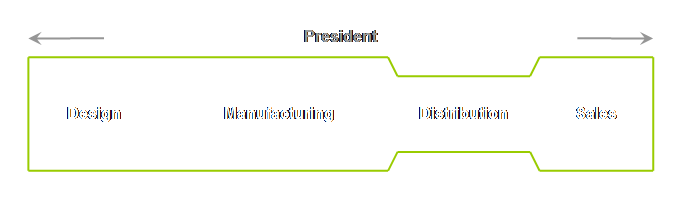
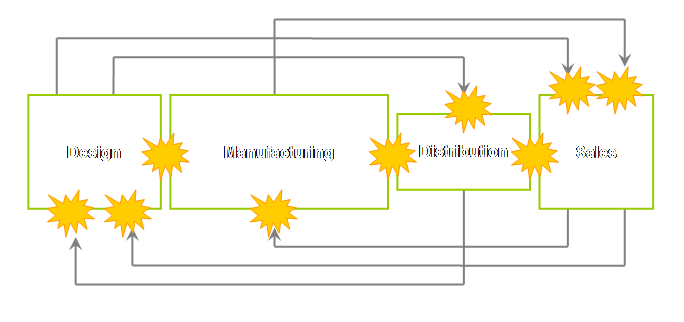
on-going improvement. Returning to our model system once more, we are trying to avoid the
reductionist/local optima approach as depicted here.
As you know from practical experience, if you have a hammer, then
everything looks like a nail. And if
you have screw then a butter knife looks like a serviceable screwdriver –
well that is until you have to put it back in the kitchen draw again. The point being we are trying to obtain collaboration and
understanding without matters disintegrating into finger pointing, or worse
still to have agreement when no agreement exists in reality in order to
preserve appearances. We want to move
from the current reductionist approach to a systemic approach as smoothly as
possible. Senge describes the myth of the management team. “All too often teams in business tend to
spend their time fighting for turf, avoiding anything that will make them
look bad personally, and pretending that everyone is behind the team’s
collective strategy – maintaining the appearance of
a cohesive team (2).” Amazing – I
don’t think Senge ever worked in Japan and yet he understands it
perfectly. Of course he was actually
referring to that paragon of free-enterprise – corporate America. It must be pretty universal then. Let’s continue with the quote.
“To keep up the image, they seek to squelch disagreement; people with
serious reservations avoid stating them publicly, and joint decisions are
watered-down compromises reflecting what everyone can live with, or else
reflecting one person’s view foisted on the group. If there is disagreement, it’s usually
expressed in a manner that lays blame, polarizes opinion, and fails to reveal
the underlying differences in assumptions and experience in a way that the
team as a whole could learn.” That’s interesting because if you have read the previous section you
will be aware that the Thinking Process provides us with a tool for exploring
differences in assumptions in a way that the whole team can learn, as you
know the method or approach is called a cloud. The same tool is specifically designed for
no-compromise outcomes – win-wins. However, the tool of choice for ensuring collaboration without finger
pointing is not the cloud, but a derivative called the 3 cloud method. This allows us to develop a no-compromise
outcome and communicate it and its ramifications to others outside of the
original decision process. We looked
at this specifically in the section on leadership and learning. The details of the methods are outlined in
the section on the communication current reality tree and the 3 cloud
method. This combination allows us to
develop an “us and our solution against the problem” without ever raising
an “us against each other” intermediate stage. Having gained agreement on the problem using these techniques,
thereafter, the normal approach using the Thinking Process tools is possible. The outcome of this process is that the leadership of all major components
of the business have developed and agreed to an implementation plan and its
execution. There is broad agreement on
how future events should unfold and the understanding necessary to modify
things to take account of new developments as they occur. Odd as it may seem at first, the holistic approach represents a
certain maturity in the sequence of the development of the Theory of
Constraint applications. One that
couldn’t have been arrived at earlier.
The logistical solutions; production, supply chain, and project
management and the non-logistical solutions can be applied individually to
firms that specialize in a particular environment but as soon as they are
applied to larger environments then the new challenge becomes how to integrate
the applications. The answer is to do
this at the outset – before any one particular application is applied – but
to do that you must also have access to all the applications. Rather like overcoming a series of physical and policy constraints within
a firm within a single application, each logistical and non-logistical
application itself also overcomes a pressing problem (how to manage) within
different parts of industry as a whole until the pressing problem is not
production, nor distribution, nor sales, nor engineering but rather how to
integrate these together as required within a single corporate strategy – to
get everyone singing from the same systemic song sheet. This is the aim of the holistic approach. (1) Goldratt, E. M., (1999) How to change an
organization. Video JCI-11, Goldratt
Institute. (2) Senge, P.
M. (1990) The fifth discipline: the art and practice of the learning
organization. Random House, pg 24. This Webpage Copyright © 2003-2009 by Dr K. J.
Youngman |